Ask ten different founders how to run a successful business, and you will likely get ten different answers focused on marketing hacks, leadership tactics, or simply “hustling harder.”
But on the front lines of scaling companies, the reality is much colder: you cannot out-work a broken economic engine.
Running a successful business is rarely about finding a magic sales channel. It is a financial engineering challenge. The companies that survive market volatility and achieve true, sustainable scale are the ones that shift their focus from generic revenue generation to absolute financial discipline.
If you want to transition from chaotic daily firefighting to intentional leadership, here is the strategic finance playbook you must adopt.
1. Stop Confusing "Profit" with "Cash"
The most dangerous illusion for a founder is a profitable Profit & Loss (P&L) statement. It is entirely possible to show record profits on paper while simultaneously sliding toward bankruptcy. Why? Because a P&L measures accounting profit, not liquid cash.
If you are closing massive deals but your clients have 90-day payment terms, your profit is trapped in a spreadsheet. You cannot pay payroll with an invoice. Running a successful business requires treating cash flow – not top-line revenue – as the ultimate metric of survival.
“Profit is a theory. Cash is a reality.”
2. Close the Working Capital Gap (You Aren't a Bank)
If you pay your suppliers in 15 days but allow your clients to pay you in 60 days, you are effectively acting as an interest-free bank for your customers. As you scale, this “Working Capital Gap” will drain your liquidity and stall your growth.
To run a tight, successful operation, you must aggressively manage this cycle:
- Accelerate Inflows: Do not wait to send invoices. Bill immediately upon delivery and offer early payment incentives (like a Net-10 discount).
- Renegotiate Outflows: Leverage your history with key vendors to negotiate extended payment terms, moving from Net-30 to Net-45 or Net-60.
- Clear Dead Stock: If you carry inventory, holding non-moving stock is literally letting cash gather dust on a shelf. Liquidate it to regain capital velocity.
3. Prune for Profit (The Courage to Fire Clients)
There is a traditional, flawed mindset that “all revenue is good revenue.” In reality, high-maintenance, low-margin clients are a parasitic drain on your premium operational capacity. They consume the bandwidth your team should be dedicating to your top-tier accounts.
One of the greatest secrets to running a successful business is understanding the “Pruning Paradox”: sometimes you have to shrink to grow. Apply the 80/20 rule to your Contribution Margin. Identify the top 20% of your services or products that generate 80% of your actual cash. Have the boardroom courage to fire the high-churn, low-margin clients that drag your business down. By doing so, you free up the resources needed to scale your true core competencies.
4. Abandon the Rearview Mirror
Most founders manage their business by looking backwards. They review last month’s financial statements to see what happened. While compliance accounting is necessary for taxes, it offers absolutely no protection against the cash crunch hitting your bank account next Tuesday.
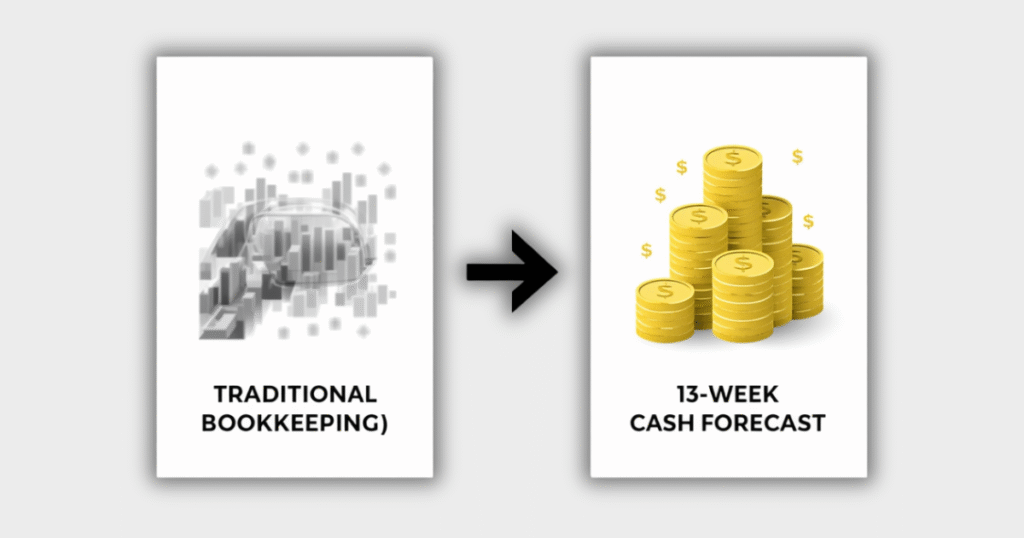
To steer a successful company, you must transition to Predictive Financial Planning & Analysis (FP&A). Implement a Rolling 13-Week Cash Flow Forecast. This dynamic model maps out your exact expected inflows and outflows, acting as a 60-day early warning system. It replaces mid-month anxiety with the power to make confident, data-backed strategic decisions before a crisis occurs.
5. Beware of "Operational Creep"
When revenue grows, complexity follows. This complexity breeds “operational creep” – the subtle, unmonitored rise of redundant software subscriptions, bloated indirect labor, and material costs that quietly siphon your margins.
You cannot scale a bucket full of holes. Conduct regular Margin Diagnostics to ensure your pricing model reflects your fully loaded costs today, not what they were three years ago.
Conclusion: From Chaos to Clarity
Learning how to run a successful business ultimately means mastering your numbers. It requires abandoning the chaos of reactive hustle and adopting the discipline of strategic financial architecture. When you optimize your margins, safeguard your liquidity, and embrace predictive modeling, your business becomes an engine that generates wealth, rather than a machine that just consumes your time.
Stop fighting fires and start fixing the engine. If you are working harder than ever but your bank balance remains stagnant, it is time to look under the hood. Uncover your hidden margin leaks and build a roadmap to profitable, cash-positive growth.