If you ask industry gurus how to grow a real estate business, you will immediately be drowning in marketing advice: buy more leads, dominate social media, host lavish open houses, and cold-call relentlessly.
But the reality of scaling a real estate brokerage or agency is far more complex. Real estate is notorious for the “feast or famine” cycle. You can close three massive deals in one month and then hit a 60-day dry spell. If you attempt to scale your operations during a feast without a bulletproof financial structure, the inevitable famine will bankrupt you.
Growth in real estate is rarely a lead-generation problem; it is a cash flow management problem. To transition from a hustling agent to a strategic CEO, you must stop chasing vanity metrics and start mastering financial engineering. Here is the strategic playbook for scaling your real estate business safely.
1. Smooth the Commission Roller Coaster (The 13-Week Forecast)
Real estate revenue is inherently “lumpy.” Because commission checks are large but infrequent, relying on your bank balance to make business decisions is a fatal error. Your Profit & Loss (P&L) statement might show a highly profitable year, but that does not prevent you from missing payroll or rent during a slow quarter.
To scale safely, you must abandon the “rearview mirror” of historical accounting and implement Predictive Financial Planning & Analysis (FP&A). By utilizing a Rolling 13-Week Cash Flow Forecast, you map out exact projected inflows (pending closings) against your fixed outflows (brokerage fees, marketing retainers, salaries). This acts as an early warning system, allowing you to spot a cash crunch 60 days before it happens and adjust your spending proactively.
2. Master Your True Customer Acquisition Cost (CAC)
Many real estate professionals bleed cash because they treat marketing like a slot machine. They pour money into online portal leads, social media ads, and mailers without calculating the exact financial return.
To run a successful real estate business, you must track your Customer Acquisition Cost (CAC) with ruthless precision.
- How much do you spend on marketing to get one closed deal?
- If your monthly ad spend on an online portal is consistently eating up half of the commission it only occasionally generates, that lead source is silently destroying your margins.
You must audit your marketing spend. Double down on the channels that produce a low CAC and high contribution margin, and have the boardroom courage to cut the expensive lead sources that generate nothing but “busyness.”
3. Beware of "Operational Creep" in Your Tech Stack
As real estate teams grow, complexity breeds “operational creep.” This is the subtle, unmonitored rise of overhead that silently eats away at your commission splits.
Real estate is heavily targeted by software companies. It is incredibly easy to bloat your monthly expenses with redundant CRMs, predictive dialers, social media schedulers, and premium staging tools. Conduct a rigorous Margin Diagnostic. Audit every recurring expense and ask: Does this tool directly decrease my CAC or accelerate my closing timeline? If not, cut it. You cannot scale a bucket with holes in the bottom.
4. The "Pruning" Paradox (Not All Clients Are Good Clients)
The traditional real estate mindset dictates that you should take every listing and work with every buyer. In a growth phase, this is a liability. High-maintenance, unrealistic clients or overpriced listings act as a parasitic drain on your resources. They consume the marketing budget and the premium operational bandwidth your team should be dedicating to high-probability closings.
Apply the 80/20 rule. Identify the top 20% of your client types or neighborhoods that generate 80% of your actual, frictionless profit. Fire the clients that drag your business down. By doing so, you free up the resources needed to dominate your core, highly profitable market.
5. Build a Capital War Chest (Don't Scale Your Lifestyle)
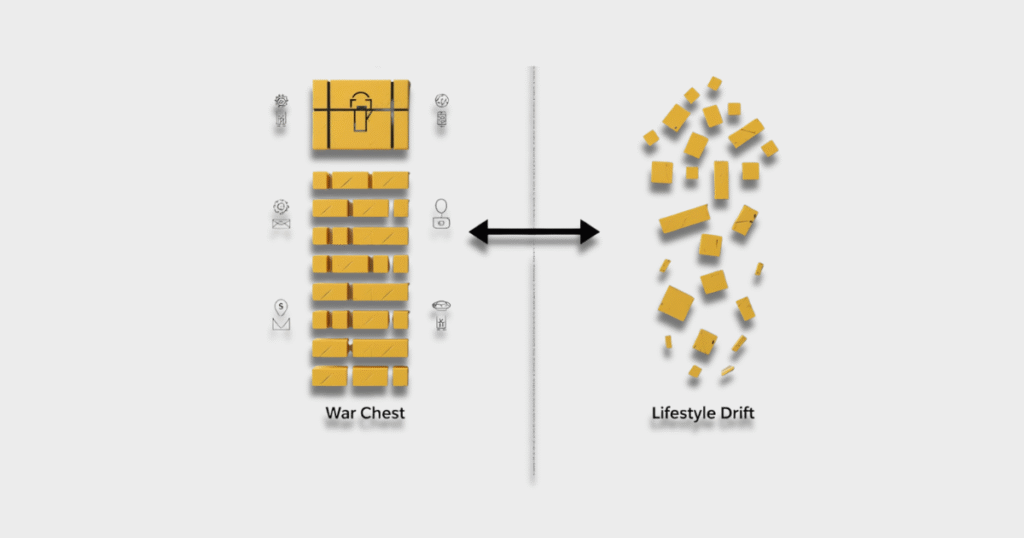
The most common trap in real estate growth is confusing business revenue with personal wealth. When a massive commission check clears, the instinctive reaction is often to upgrade the car, the office, or personal lifestyle.
Strategic growth requires retaining capital. Real estate is highly sensitive to macroeconomic factors like interest rates and local market shifts. A successful real estate business builds a “War Chest” – a cash reserve that covers 3 to 6 months of operating expenses. This ensures that when the market dips (and it always does), you have the liquidity to buy up the market share your under-capitalized competitors are abandoning.
Conclusion: From Hustle to Architecture
Learning how to grow a real estate business ultimately means stepping off the transactional treadmill and building a predictable economic engine. When you optimize your marketing spend, smooth out your cash flow, and build structural liquidity, you stop just closing deals and start building real enterprise value.
Stop fighting the feast-or-famine cycle. If you are closing deals but your bank account is constantly stressed, it is time to look under the hood. Uncover your hidden margin leaks and build a roadmap to predictable, cash-positive growth.