You’re doing ₹30 – 40 Cr in revenue.
Sales are moving. The team is busy. Your accountant shows you a profit number. On paper, things look stable.
And yet:
- Cash flow feels tighter than it should.
- Margins fluctuate unexpectedly.
- Debt slowly increases.
- You’re unsure which customers actually make you money.
- Every budgeting discussion turns into a debate.
You’re not alone.
Most founders I work with are not confused about revenue.
They’re confused about performance.
The problem is not the numbers themselves.
It’s how the numbers are being read.
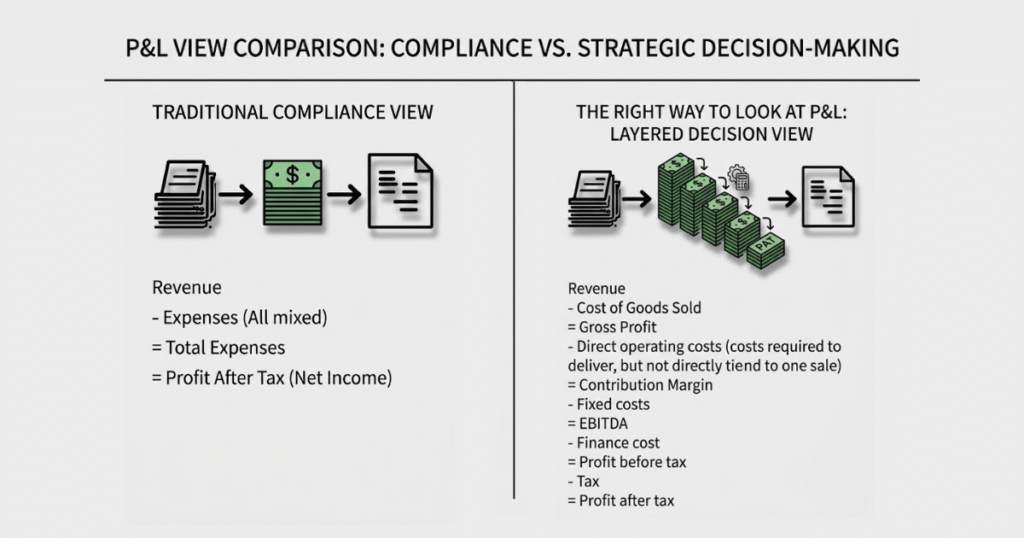
If you’re only looking at Revenue – Expenses = Profit, you’re looking at your business through a compliance lens.
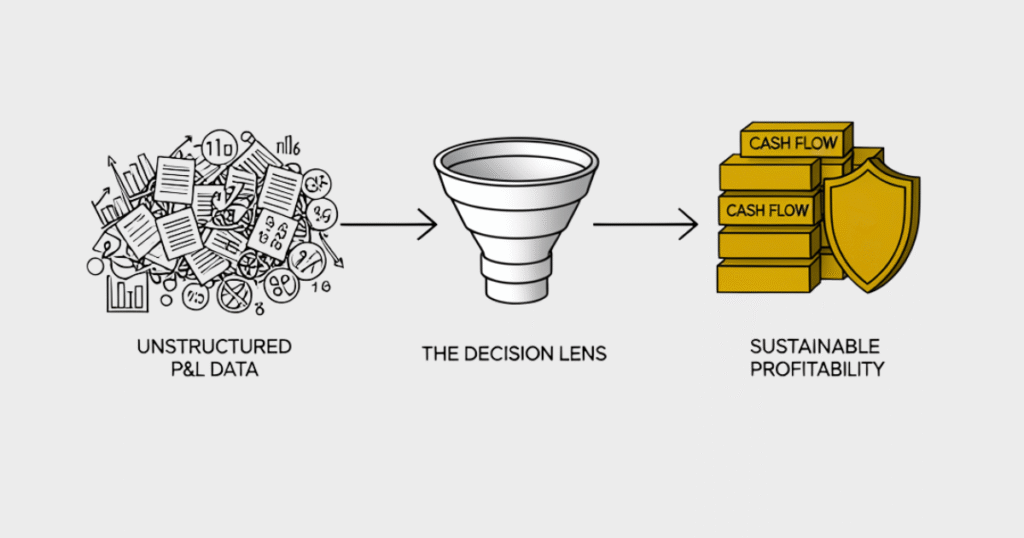
What you need is a decision-making lens.
Why Founders Struggle With This
Your P&L is prepared for accuracy and tax compliance. It follows accounting standards. It answers the question:
“Are we profitable?”
But as a founder, that’s rarely your real question.
You’re asking:
- Which part of my business is driving profitability?
- Are we scaling efficiently?
- Is cash flow aligned with profit?
- Are we funding growth or funding inefficiency?
Here’s the blind spot:
Traditional P&L formats mix together costs that behave very differently.
Variable costs, fixed costs, operational inefficiencies, and finance costs often sit in one long list. It becomes difficult to see what’s structural and what’s situational.
So founders react to outcomes (PAT, EBITDA) instead of managing drivers.
That’s where financial clarity starts breaking down.
A Better Way to Think About Your P&L
Instead of stopping at profit, break your numbers into layers.
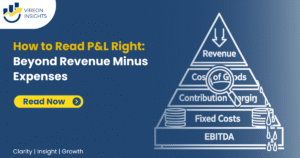
Here’s a simple mental model:
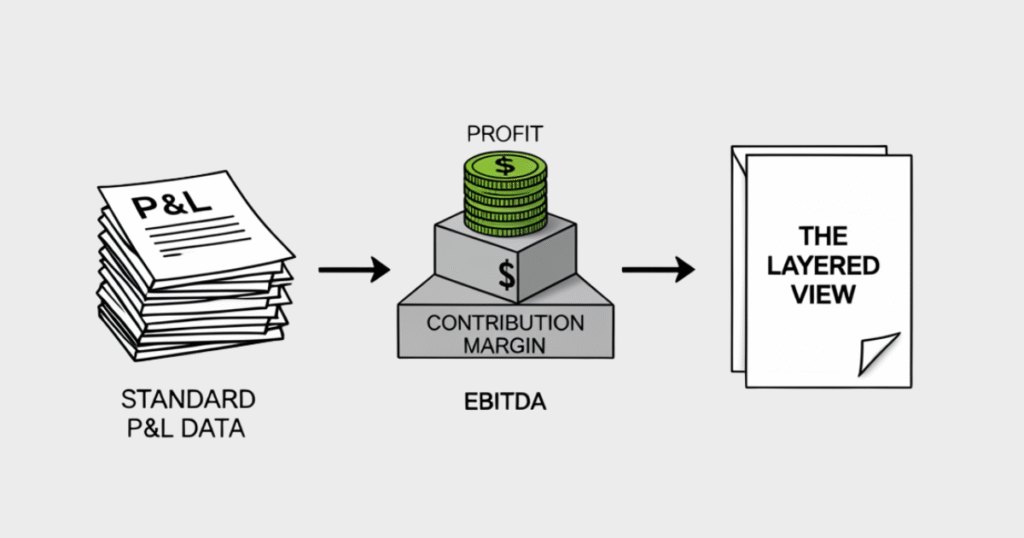
This layered view separates performance from structure.
It helps you see:
- Whether your pricing and production economics are sound (Gross Profit).
- Whether your business model works at a contribution level.
- Whether your cost structure matches your scale.
- Whether debt is supporting growth or compensating for weak cash flow.
Profit is the outcome.
Contribution and cost structure are the levers.
That distinction changes decision-making.
How This Shows Up in Real Businesses
Let’s look at two common founder scenarios.
Scenario 1: Growing Revenue, Stagnant Profit
A manufacturing company increases revenue by 20%. EBITDA improves slightly. But cash flow doesn’t improve.
When we restructure the P&L, we discover:
- Contribution margin is weak on large clients.
- Discounts are high.
- Direct operating costs are rising faster than revenue.
Revenue growth masked margin erosion.
Without this layered view, the natural reaction would have been: “Push more sales.”
The better reaction: Fix contribution first.
Scenario 2: Healthy EBITDA, Weak PBT
Another business shows strong EBITDA. On paper, operations look fine.
But PBT is low because finance cost is high.
When analysed further:
- Working capital is stretched.
- Collections are slow.
- Short-term borrowing funds operations.
The business is profitable operationally but structurally stressed.
In this case, the issue isn’t profitability – it’s cash flow discipline.
Two very different problems.
Two very different solutions.
Both hidden in a standard P&L format.
What Founders Should Focus On
You don’t need complex models to improve business performance. You need better questions.
When reviewing numbers, ask:
- Is our contribution margin stable or shrinking?
- Are fixed costs growing faster than revenue?
- Is finance cost proportional to risk?
- Does profit convert into cash?
- Which customers or segments dilute margin?
In budgeting discussions, focus on cost behaviour:
- What moves with revenue?
- What stays regardless of scale?
This improves decision-making dramatically.
It prevents over-hiring too early.
It prevents scaling low-quality revenue.
It prevents debt from silently compounding.
Financial clarity is not about more reports.
It’s about sharper interpretation.
Leadership & Mindset Considerations
As a founder, your behaviour sets the tone.
If you only ask for revenue updates, the team will optimise for revenue.
If you ask about contribution and cash flow, behaviour changes.
Strong founders separate ego from numbers.
They’re willing to:
- Exit low-margin clients.
- Revisit pricing.
- Slow down growth to stabilise structure.
- Challenge assumptions around “market pressure.”
The goal is not just profitability.
It’s sustainable profitability.
When you read your P&L in layers, you move from reacting to results to shaping outcomes.
That shift reduces anxiety.
It also improves confidence.
Because you’re no longer guessing where the problem lies.
From Information to Better Decisions
Your accountant prepares numbers correctly.
But leadership requires a different view.
When you restructure your P&L for decision-making:
- Profitability becomes clearer.
- Cash flow conversations become grounded.
- Budgeting becomes practical.
- Growth decisions become more intentional.
You don’t need more data.
You need a better lens.
If this perspective resonates, you may find value in exploring our deeper 2-page note or subscribing to insights we share regularly around financial clarity and business performance.
The right way to look at your numbers doesn’t complicate your life. It simplifies your decisions.