The Strategic Founder’s Guide: 10 Ways to Grow Your Business Safely
Most founders assume that growth solves all problems. The reality is that rapid expansion often breaks the systems that got you to your current level. If you scale without a solid financial foundation, you risk overtrading, exhausting your working capital, and diluting your profit margins.
If you are looking for 10 Ways to Grow Your Business you have likely been bombarded with marketing hacks and sales tactics. However, sustainable growth is rarely about finding a new advertising channel; it is about building an economic engine that can support scale.
Here are ten strategic, financially grounded ways to grow your business while maintaining absolute control over your cash flow and profitability.
1. Optimize Your Pricing Strategy
Growth does not always require new customers. Often, the fastest path to expanding your bottom line is adjusting your pricing to reflect your true value. “Operational creep” – the steady rise in material costs and software subscriptions – silently eats away at your margins over time. Conduct a thorough margin diagnostic to ensure your current pricing model actually covers your fully loaded costs and leaves room for scale.
2. Prioritize Contribution Margin Over Top-Line Revenue
Not all revenue is created equal. Many businesses chase top-line vanity metrics by selling high volumes of low-margin products or services. To grow sustainably, shift your focus to the contribution margin (what is left after direct variable costs). Identify the top 20% of your offerings that generate 80% of your actual cash, and funnel your growth capital directly into those core competencies.
3. Tighten Your Working Capital Cycle
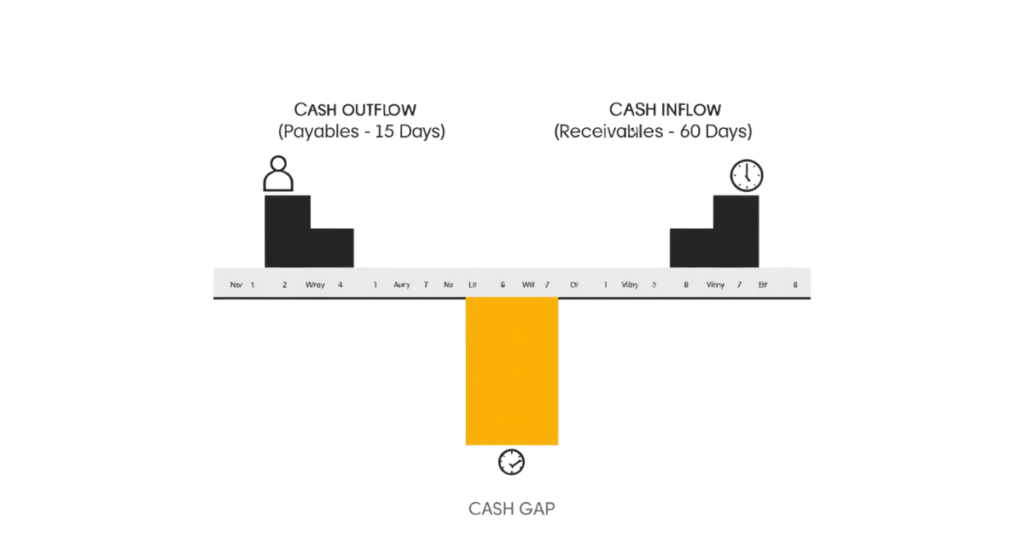
You cannot fund growth if your cash is trapped in unpaid invoices. If you pay your suppliers in 15 days but your clients take 60 days to pay you, growth will literally bankrupt you. Tighten this cycle by:
- Invoicing immediately upon delivery.
- Offering small discounts (e.g., Net 10) for early payment.
- Renegotiating longer payment terms with your long-term vendors.
4. Prune Unprofitable Customer Segments
It requires boardroom courage, but sometimes the best way to grow is to shrink. High-maintenance, low-margin customers act as a parasitic drain on your resources. “Firing” a bad client frees up your team’s bandwidth, allowing you to redirect that premium operational capacity toward acquiring and serving highly profitable, ideal accounts.
5. Implement a Rolling 13-Week Cash Forecast
You cannot steer a growing company by looking in the rearview mirror. Historical accounting only tells you what happened last month. To safely pursue new growth initiatives, you must implement a rolling 13-week cash flow forecast. This predictive model acts as an early warning system, allowing you to see cash crunches 60 days before they hit and make strategic decisions with confidence.
6. Align Your Capital Structure with Your Life Cycle
A common growth error is funding long-term expansion (like buying equipment or building a new facility) with short-term, high-interest debt or operational cash flow. This starves your daily operations. Ensure your capital structure makes sense: fund daily working capital through operational cash, and fund long-term assets through appropriate long-term debt or equity.
7. Liquidate Dead Stock and Unused Assets
For businesses managing physical inventory, your warehouse is often where working capital goes to die. Holding “dead stock” – inventory that isn’t moving – is the equivalent of a stack of cash gathering dust. Implement data-backed demand planning to keep inventory lean. Liquidate non-moving items immediately; taking a small loss on margins is better than having zero liquidity when you need to fund a new growth phase.
8. Invest in Scalable Systems, Not Just Headcount
When sales spike, the instinctive reaction is to hire more people. However, throwing headcount at a broken process only scales inefficiency. Before adding payroll overhead, audit your internal operations. Can you automate your onboarding? Can you integrate your CRM with your accounting software? Build systems that can handle 3x your current volume so you don’t have to hire linearly as you grow.
9. Form Strategic, Non-Competing Partnerships
Acquiring new customers is expensive. Instead of relying solely on direct marketing, look for adjacent, non-competing businesses that serve your exact target audience. Co-hosting webinars, bundling services, or creating referral agreements allows you to tap into established trust and scale your audience without absorbing massive Customer Acquisition Costs (CAC).
10. Shift from "Rearview" Bookkeeping to Strategic FP&A
Ultimately, the most powerful way to grow your business is to change the lens through which you view it. Standard compliance accounting answers the question, “Are we profitable?” Strategic Financial Planning & Analysis (FP&A) answers the question, “Which levers do we pull to double our cash flow next quarter?” Upgrading your financial visibility is the ultimate catalyst for scalable growth.
Conclusion: Scale with Clarity
True business growth is deliberate, measured, and structurally sound. It requires moving from a state of reactive “firefighting” to a state of intentional strategy. By optimizing your margins, protecting your liquidity, and implementing predictive financial models, you ensure that your business doesn’t just get bigger – it gets stronger.
Ready to stop guessing and start scaling? If you are tired of working harder without seeing the cash in your bank account, it is time to look under the hood. Let’s uncover your hidden margin leaks and build a roadmap to profitable growth.