As businesses grow, dashboards usually grow with them.
More metrics. More charts. More reports.
Yet many founders quietly admit something uncomfortable:
“We see the numbers every month – but decisions still feel reactive.”
The issue isn’t lack of data.
It’s how data is being used.
The Real Problem: Confusing Monitoring With Decision-Making
Not all metrics serve the same purpose.
Some tell you what already happened.
Others help you decide what to do next.
When these get mixed up, dashboards start creating comfort instead of control.
Understanding the Two Types of Metrics That Matter
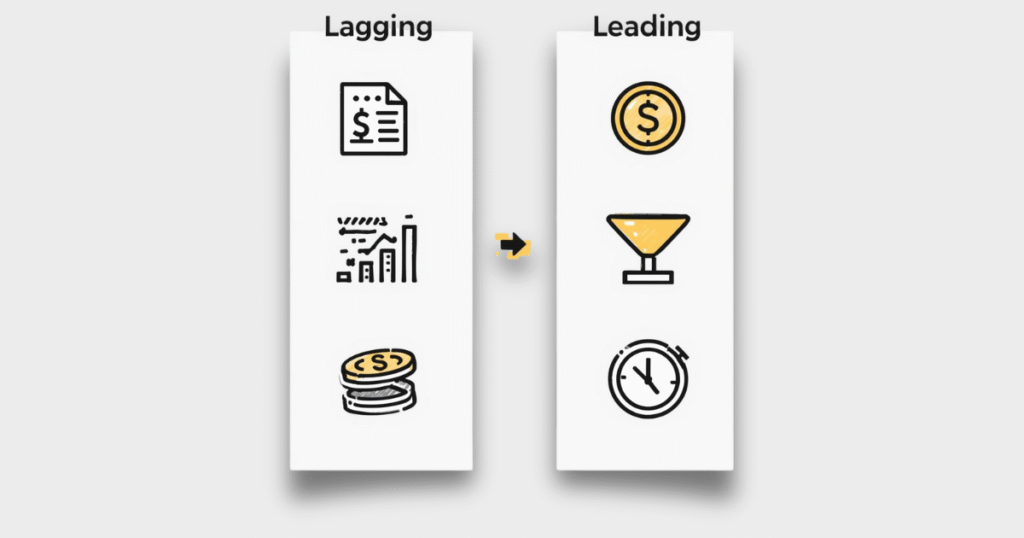
1. Lagging Indicators - Necessary, but Not Enough
Lagging indicators reflect outcomes of past decisions.
Common examples:
- Revenue
- Contracts signed
- EBITDA
- Cash balance
- Market share
Why they matter
- They confirm results
- They help track overall health
- They keep leadership aligned
Where founders go wrong
- Using them as reassurance instead of inquiry
- Feeling “things are fine” because revenue is growing
- Missing early warning signs underneath the surface
Revenue growth doesn’t automatically mean the business is getting stronger.
It may be driven by pricing, backlog, or one-time demand – while margins, scalability, or cash discipline weaken.
Lagging indicators should trigger questions, not confidence.
2. Leading Indicators - The Real Drivers of Control
Leading indicators show what is likely to happen next.
They are closer to daily decisions and operational reality.
Examples:
- Contribution margin by product / client
- Sales pipeline quality (not just size)
- Cost per acquisition vs lifetime value
- Capacity utilization
- Working capital cycle trends
- Forecast vs actual movement mid-month
Why they matter
- They reveal stress early
- They show trade-offs before damage is done
- They enable course correction, not post-mortems
If lagging indicators tell you what happened,
leading indicators tell you what will happen if nothing changes.
So Is Revenue a Vanity Metric?
No.
Revenue is a monitoring metric, not a vanity metric by default.
It becomes a vanity metric when:
- It’s celebrated without understanding quality
- It hides margin erosion
- It delays tough decisions
- It creates false comfort
Revenue should stay on the dashboard – but it should not dominate attention.
The mistake isn’t tracking revenue.
The mistake is taking comfort in it.
The Dashboard Test Every Founder Should Apply
Before adding or keeping any metric, ask:
“If this number moves by 10%, would it force a decision or trade-off?”
- If yes → it’s a decision-driving metric
- If no → it’s a monitoring metric
Both are useful – but they serve different roles.
A strong dashboard:
- Uses monitoring metrics for awareness
- Uses decision metrics for action
Why Fewer Metrics Often Lead to Better Decisions
This doesn’t mean cutting metrics blindly.
It means:
- Reducing decision noise
- Separating signal from reassurance
- Making trade-offs visible
When dashboards are overloaded:
- Leaders revert to gut instinct
- Decisions slow down
- The same surprises repeat every month
Clarity doesn’t come from more data.
It comes from better framing.
What High-Confidence Leaders Do Differently
They:
- Track lagging indicators without emotional attachment
- Pay disproportionate attention to leading signals
- Use numbers to surface trade-offs, not confirm beliefs
- Ask “what changed?” instead of “are we okay?”
Strong businesses aren’t built on perfect numbers.
They’re built on numbers leaders trust enough to act on.
The Takeaway
- Track revenue, contracts, and profit – but don’t take comfort in them
- Focus leadership attention on metrics that change decisions
- Use dashboards to reveal trade-offs early, not explain surprises late
When financial data shifts from reporting to decision-making,
growth becomes predictable – not stressful.