In a climate of unrelenting volatility, the most seductive trap for a CEO is the belief that sheer effort can outrun a broken economic engine. When faced with a cash flow crisis or plummeting margins, the instinctive response is “firefighting” – running faster, working longer hours, and pushing teams to the brink. However, intensity is not a substitute for integrity in your business model.
The question that defines the survival of your enterprise is not how much sweat you are investing, but rather: “Are we just working harder, or are we working on the right things?” Moving from a state of constant reaction to one of intentional growth requires more than tactical hustle; it requires a surgical pivot from chaos to clarity.
5 Hard Truths About Turning Crisis Into Clarity
1. Recovery is a Strategic Blueprint, Not an Emergency Checklist
In our experience, the most fatal error a CEO can make is misdiagnosing a fundamental economic failure as a temporary disruption. Too often, leaders confuse a Business Recovery Plan (BRP) with a Disaster Recovery Plan. While the latter is a reactive protocol for IT outages or physical threats, a BRP is an offensive strategy focused on the company’s economic engine.
A Business Recovery Plan addresses the viability of the capital structure itself. It is the ultimate opportunity to transform financial complexity into strategic clarity, identifying the structural leaks that drain resources and providing the roadmap to pivot back to sustainable profitability. Without this distinction, you are merely patching holes in a sinking ship rather than redesigning the hull.
“A recovery plan is not just an emergency checklist; it is a strategic blueprint to restore financial health, stabilize operations, and realign the business with its long-term growth objectives.”
2. The "Pruning" Paradox (The 80/20 Rule of Profitability)
Distress is rarely the result of a single catastrophic event; more often, it is a symptom of “operational creep.” This occurs when a business grows more complex than its underlying systems can support, allowing inefficiencies to hide in the shadows of expansion.
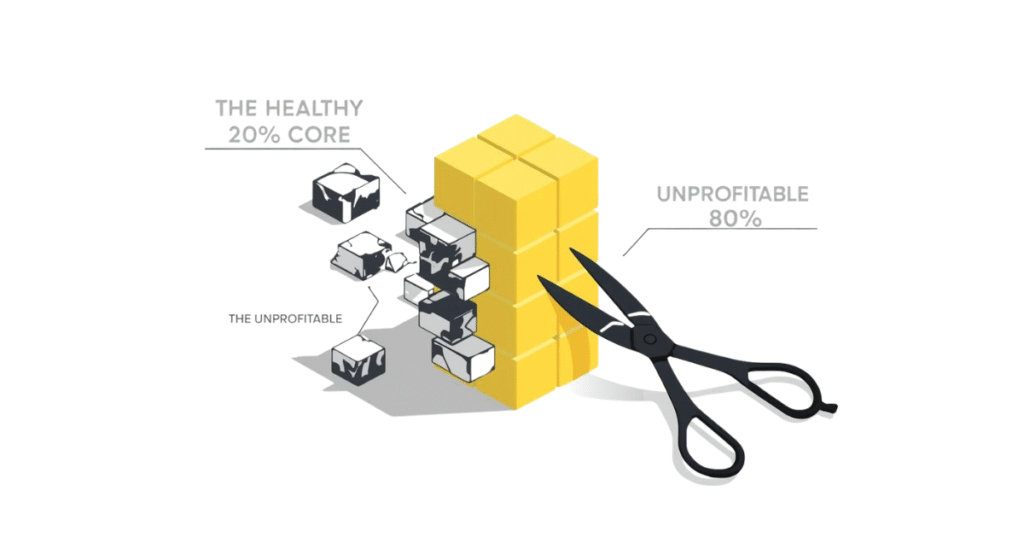
Strategic recovery demands a ruthless “Core Competency Focus.” Data invariably shows that the top 20% of your products or services generate 80% of your contribution margin. The hard truth is that by maintaining unprofitable lines, you are effectively subsidizing failure with the profits of your high-performers. This “complexity tax” starves your winners of the capital they need to scale. To save the healthy core of the business, the CEO must embrace the pruning paradox: you must cut away the dead weight to allow the rest of the enterprise to breathe and grow.
3. Not All Revenue is Good Revenue
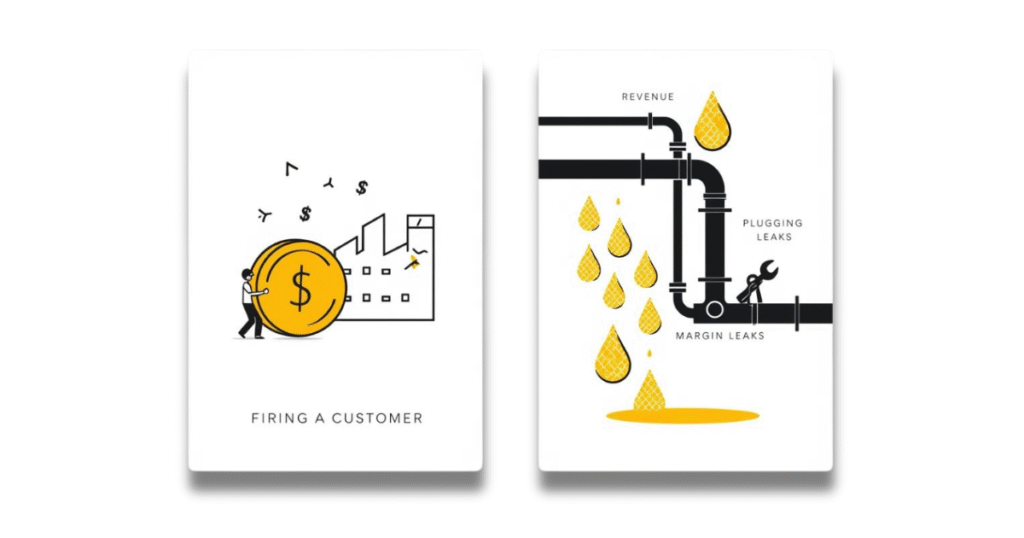
The Courage to Cut: Firing Your Customers The traditional growth mindset dictates that any revenue is positive revenue. In a recovery phase, this assumption is a liability. High-cost, low-margin customers act as a parasitic drain on your resources. “Firing a customer” is often the quickest path to stabilization. It requires the boardroom courage to identify high-churn segments that demand excessive support and either renegotiate their terms to ensure viability or exit the relationship entirely.
Plugging the Structural Leaks You cannot scale a bucket full of holes. Recovery requires a visceral look at where your margin is leaking. This often involves auditing unoptimized vendor contracts that were signed during periods of high growth and low scrutiny. Success in a turnaround is defined by the quality of your revenue and the tightness of your operations, not the sheer volume of your top line.
4. Stop Looking in the Rearview Mirror
A common failure point in business recovery is managing through historical accounting. By the time a P&L statement is finalized, it represents a reality that has already passed. Relying on these “rearview mirror” metrics prevents leaders from seeing the structural leaks causing their current distress in real-time.
The antidote is predictive financial modeling. Founders are frequently too close to the daily “firefighting” to maintain the objectivity needed to see structural patterns. This structural blindness leads to a focus on effort rather than architecture. A consultant’s value lies in providing the distance necessary to separate daily performance from the overall viability of the business model.
“The most common reason for failure isn’t a lack of effort – it’s a lack of perspective.”
5. The 90-Day Sprint (A Plan Without a Timeline is a Wish)
A successful recovery cannot be an open-ended intellectual exercise. It must be executed as a high-intensity, 90-day sprint fueled by specific Key Performance Indicators (KPIs) and uncompromising deadlines. This structure is what moves an organization from wishful thinking to growth stabilization.
The roadmap for a professional-grade recovery follows a strict cadence:
- Weeks 1-4: Liquidity and Diagnostic. This phase focuses on immediate preservation. Conduct a comprehensive cash flow audit, identify every margin leak, and implement strict spending controls to halt the bleed.
- Weeks 5-8: Structural Changes. This is the “heavy lifting” phase. Execute necessary debt restructuring to align your capital with your current life cycle, perform cost realignment, and finalize the pruning of unprofitable lines or processes.
- Weeks 9-12: Market Re-entry. With the foundation stabilized, refresh your value proposition and re-engage the market with a sharpened focus on high-margin, high-viability segments.
Conclusion: From Reaction to Intention
The transition from financial distress to sustainable health is a bridge built on structure, discipline, and clarity. By abandoning the chaos of reactive firefighting and adopting a structured Business Recovery Plan, a company can realign its daily operations with its long-term strategic objectives. The goal is not just to survive the current volatility, but to emerge with a more resilient economic engine.
As you evaluate your current trajectory, ask yourself: Is your current strategy building a bridge to the future, or just managing the fires of the past?
Stop fighting fires and start fixing the engine. If you are ready to uncover your structural margin leaks and build a 90-day execution roadmap to turn your crisis into clarity, let’s talk.








 Clarity | Insight | Growth